
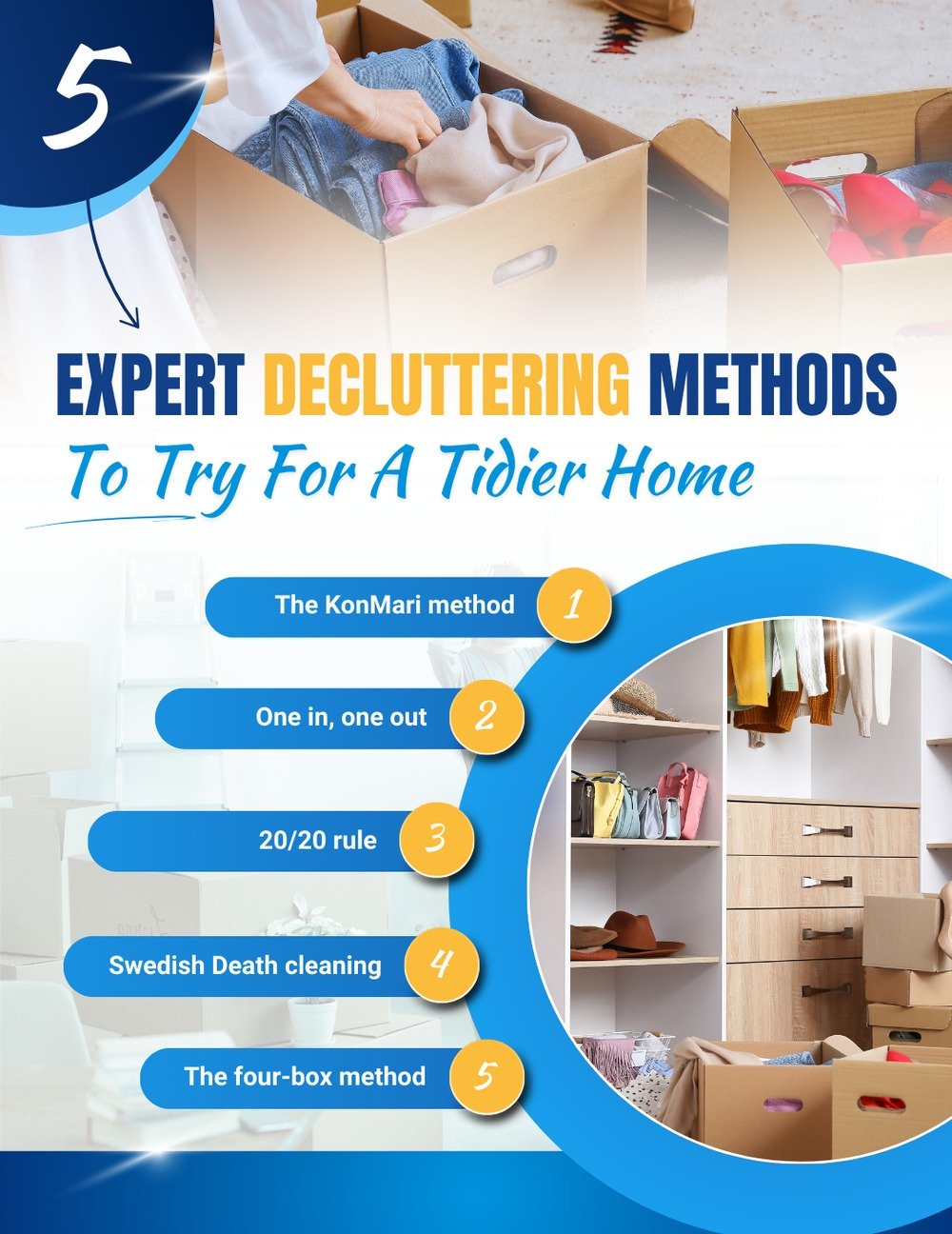

What Is the Kon Mari Method™?
The KonMari Method™ is probably one of the most famous decluttering methods, introduced by Japanese organizing consultant Marie Kondo in her 2014 bestselling book “The Life-Changing Magic of Tidying Up.” She also starred in her own Netflix show, “Tidying Up With Marie Kondo.”Who Is It For?
- People Who Love Mindfulness and Intentional Living Can Greatly Identify with this approach.
Any Drawbacks?
The KonMari method can be time-consuming since you will be sorting through your entire stuff instead of focusing on a particular room or space. Additionally, this is not entirely a minimalist method as it can also encourage hoarders and pack rats to continue keeping things they don't need, just because they think these items still spark joy in their lives.
What Is the One-In, One-Out Technique?
Who Is It For?
-
Perfect for impulsive buyers, especially those who always love to shop for clothes and other personal items. Keeping this in mind can help you avoid unnecessary purchases and teach you how to be less materialistic. Before buying an item, it will make you stop and think first: “Do I really need this item?” “Do I have a similar item that serves the same purpose?” “Is there something I am willing to let go of in return?”
-
Homeowners who want to try a strict approach this year can follow this one, especially if you’ve just finished decluttering or are in the process of it.
Any Drawbacks?

What Is the 20/20 Rule?
This rule is simple: If you are unsure about an item but it costs under $20 and could be replaced within 20 minutes, you can declutter it.Who Is It For?
-
For those who need a low-commitment push to get started on their decluttering journey, especially if they have a nice pile of things that haven't been used for months or years.
-
Perfect for those “I-could-use-it-one-day” or “just in case” items, such as when purging your kitchen or junk drawers
Any Drawbacks?
You may not be able to apply this tactic to a lot of sentimental items, since if they are really sentimental, then they can’t be replaced for less than $20 in 20 minutes.
What is the Swedish Death Cleaning method?
While this decluttering idea sounds morbid, the intention is important and meaningful. Swedish Death Cleaning was first introduced by Margareta Magnusson in her book Dostadning: The Gentle Art of Swedish Death Cleaning. Dostadning, or the art of death cleaning, is a Swedish phenomenon by which the elderly and their families set their affairs in order.Who Is It For?
-
While the original intention is for the elderly or those who are in their later years of life, Magnusson points out that people of any age can use Swedish Death Cleaning to help them declutter and organize. This is especially true when you realize that you can hardly close your drawers or cabinets.
Any Drawbacks?
It’s worth noting that the Swedish Death Cleaning is designed to be slow, so expect that it can be a long and thorough process.
What Is the Four-Box Method?
As the name suggests, all you need here are four empty boxes that you will label with their purpose. While there are some variations, most experts include the following: keep, trash or throw away, donate, and sell. Other variations also include ‘rehome' and ‘undecided.’Who Is It For?
-
Highly recommended for those who are just starting their decluttering journey because of its simplicity and effectiveness.
-
Those who are decluttering small, dedicated spaces can also benefit from this method.
-
Go for this if you like putting things in fixed categories.
Any Drawbacks?
While this strategy is pretty straightforward, the problem comes when you become indecisive on a lot of items and everything ends up in the ‘undecided’ box. If you don’t have the time or confidence to address them later, you might end up with piles of miscellaneous items that will either just stay in the box or clutter up other areas of your home. The key is to follow through with what you’re supposed to do with your stuff according to the category they fall under. Also, you may need a little guidance when it comes to deciding on things that fall into one or more categories.